|
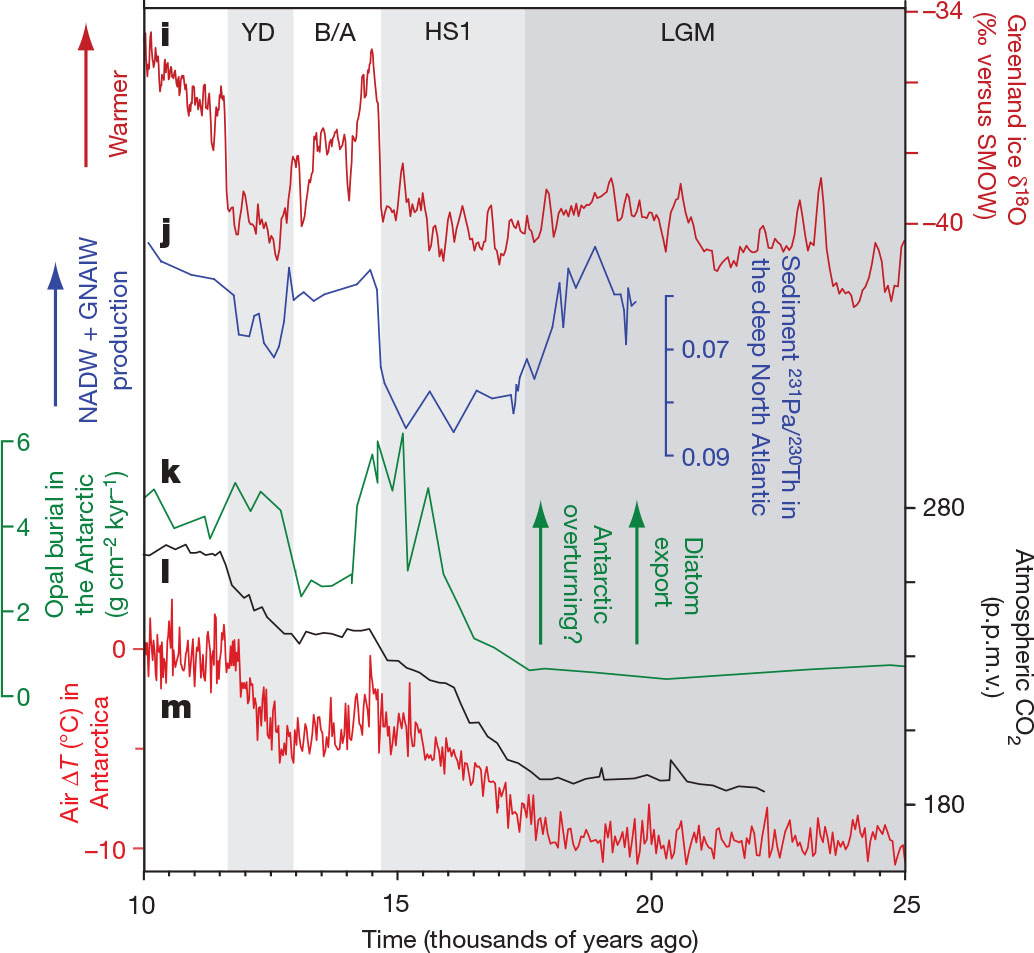
Rapid Climate Change During the Younger DryasBackgroundThe Younger Dryas (12,900 to 11,500 yrs Before Present) is characterized by significant changes in surface temperatures, overturning of the deep-sea circulation and marine productivity (Figure 1; Sigman et al., 2010). Comparison of δ18O from Greenland ice core records with temperature reconstructions from Antarctica indicates opposite signals. The Antarctic record and the Culverson Creek Cave record in West Virginia demonstrate a warming trend during the YD, whereas the measurements from Greenland favor a strong cooling. A considerable controversy exists in explaining the Greenland YD cooling: The 231Pa/230Th activity ratio of a North Atlantic sediment core suggests that the North Atlantic overturning was moderately reduced during the YD (see also He, 2011), whereas the cooling and the subsequent warming in the Greenland ice core are very pronounced. This discrepancy could potentially be explained by changes in the temperature–oxygen-isotope relationship during the YD (Brady, pers. comm.).
Figure 1. The GISP2 (Greenland) record of ice δ18O, a measure of local air temperature, when compared with the Antarctic reconstruction of temperature, shows that the Antarctic led deglacial warming, with a hiatus in Antarctic warming during Greenland’s Bølling–Allerød (B/A) warm period and a resumption of Antarctic warming during Greenland’s Younger Dryas (YD) cold period. For the Younger Dryas, a controversy exists: The 231Pa/230Th activity ratio of a North Atlantic sediment core (j) suggests a moderate reduction in North Atlantic export of subsurface water at the onset of the Younger Dryas cold period, whereas the cooling and the subsequent warming at the Greenland ice core (i) is more pronounced (see Liu et al., 2009). During the Younger Dryas, Antarctica warmed (m), Antarctic biogenic opal production increased (k), and atmospheric pCO2 rose (l), suggestive of increased Antarctic overturning and CO2-release. SMOW and PDB refer to Standard Mean Ocean Water and Pee Dee Belemnite, both isotopic reference materials (graph from Sigman, 2010). |
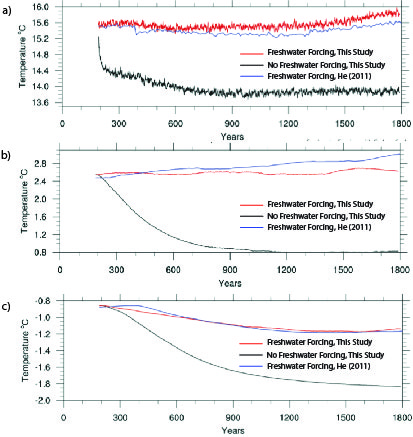
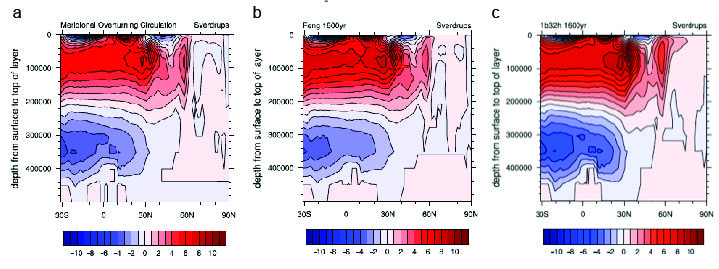
Rapid Climate Change in Response to Freshwater ForcingTwo Younger Dryas experiments have been conducted with CCSM3 including a marine OCMIP type-biogeochemical module (Doney et al., 2006; Winguth et al., 2013) that contains a diagnostic prediction of stable isotope tracer δ13Cbio (Broecker and Maier-Reimer, 1992; Winguth et al., 1999) and stable oxygen isotopes (Labeyrie et al., 1992; Soni, submitted). Both simulations were integrated using 13.1 ka initial conditions from He (2011) and have been integrated for 1,600 years. The first experiment considers freshwater hosing as discussed above and the second was carried out without freshwater hosing.Time series of simulated temperature by CCSM3 are compared with those of He (2011) as shown in Figure 2. Figure 2a represents the global mean sea surface temperature and Figures 2b and c represent temperatures at ~1100 meters and ~4000 meters, respectively. In all three depths, the temperatures between the red and blue lines correlate well, showing a reduced temperature response to the Younger Dryas climate. The red line reports temperatures approximately 0.5°C warmer than values given by He (2011). In contrast, the black line would be more consistent to the cooling as inferred from the Greenland ice core records. The Atlantic meridional overturning circulation (AMOC) for our two simulations and that of He (2011) are represented by Figure 3. When the simulation without freshwater forcing is compared to those with freshwater forcing a significant decrease of the AMOC of approximately 3 Sverdrups (Sv) is observed. This shows that the magnitude of fresh water forcing is of importance to reconstructing the Younger Dryas climate. The simulation without freshwater forcing is comparable to the present-day ocean circulation.
Figure 2. Global Surface Temperature for a) the surface of the ocean, b) 1100 meters and c) 4000 meters in degrees Celsius.
Figure 3. Strength of the Atlantic meridional overturning circulation with (a) and without (b) the influence of freshwater forcing during the Younger Dryas. For comparison the study of He (2011) is shown (c). |
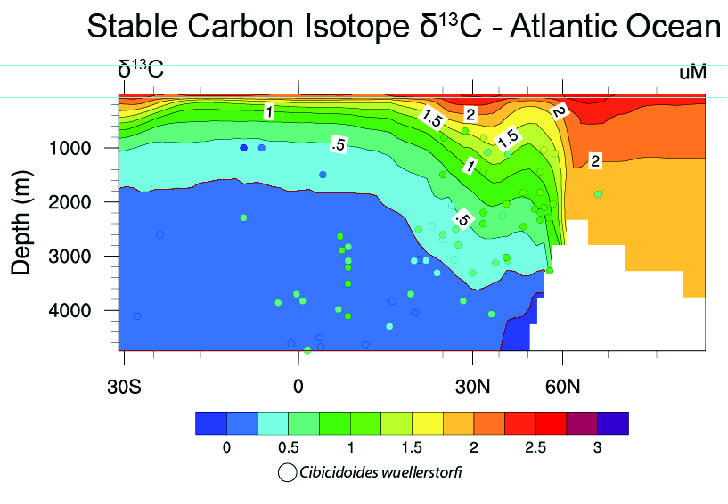
Comparison of Climate Simulations with the PaleorecordThe simulated carbon isotope δ13C for the scenario with freshwater pulse from CCSM3 was averaged zonally over the Atlantic Ocean (Figure 4) and compared with δ13C measurements in epibenthic C. wuellerstorfi (Sarnthein et al., 1994) from different locations. Simulated δ13C values for the surface waters were not considered because air-sea gas exchange of δ13C is parameterized by the Broecker and Maier-Reimer (1992) approximation. Observed data correlates relatively well for the entire water column as is. To account for biological processes involved in the carbon cycle, approximately 0.4 μmoles would need to be subtracted from all values (Sarnthein et al., 1994).
Figure 7. δ13C was averaged zonally over the Atlantic Ocean, and the values given by the CCSM3 simulation with freshwater forcing are compared with δ13C reconstructions from epibenthic C. wuellerstorfi from different locations (Sarnthein et al., 1994). |
References and Additional LiteratureBakke J, Lie Ø, et al., 2009. Rapid oceanic and atmospheric changes during the Younger Dryas cold period. Nature Geoscience, 2(3), 202-205. Broecker, W.S.., and E. Maier-Reimer, 1992. The influence of air and sea exchange on the carbon isotope distribution in the sea. Global Biogeochemical Cycles, 6(3), 315-320. He, F., 2011. Simulating Transient Climate Evolution of the Last Deglaciation with CCSM3. Ph.D. Thesis, University of Wisconsin-Madison, 171 pp. Huang E.Q. and Tain, J., Melt-Water-Pulse (MWP) events and abrupt climate change of the last deglaciation, Chinese Science Bulletin, 53(18), 2867-2878 Labeyrie, L.D., Duplessy, J., Duprat, J., Juillet-Leclerc, A., Moyes, J., Michel, E., Kallel, N., and Shackleton, N.J., 1992. Changes in the vertical structure of the North Atlantic Ocean between glacial and modern times. Quaternary Science Reviews, 11, p. 401-413. LeGrande, A.N., and G.A. Schmidt, 2006. Global gridded data set of the oxygen isotopic composition in seawater. Geophys. Res. Lett., 33, L12604, doi:10.1029/2006GL026011. Peltier, W.R., Vettoertti, G., Stastna, M., 2006. Atlantic meridional overturning and climate response to Arctic Ocean freshening. Geophysical Research Letters, 33, 1-4. Sarnthein, M., Winn, K., Jung, S., Duplessy, J., Labeyrie, L., Erlenkeuser, H. and Ganssen, G., 1994. Changes in east Atlantic deepwater circulation over the last 30,000 years: Eight time slice reconstructions. Paleoceanography, 9(2), 209-267. Sigman, D.M., Mathis P. Hain, Gerald H. Haug, 2010. The polar ocean and glacial cycles in atmospheric CO2 concentration. Nature, 466, 47-55, doi:10.1038/nature09149. Soni, Anand. The effect of freshwater input on δ18O distribution at the Younger Dryas, M.S. Thesis, University of Texas at Arlington, 69 pp.(submitted). Yeager, S.G., C.A. Shields, W.G. Large, and J.J. Hack, 2006. The Low-Resolution CCSM3. Journal of Climate, 19(11), 2545-2566. Weijer, W., M. E. Maltrud, M. W. Hecht, H. A. Dijkstra, and M. Kliphuis, 2012. Response of the Atlantic Ocean circulation to Greenland Ice Sheet melting in a strongly-eddying ocean model. Geophysical Research Letters, 39, L09606, doi:10.1029/2012GL051611. Winguth, AME., Thomas, E., Winguth, C., 2012. Global decline in ocean ventilation, oxygenation, and productivity during the Paleocene-Eocene Thermal Maximum: Implications for the benthic extinction. Geology, 40(3), 263-266. Winguth, A.M.E., D. Archer, E. Maier-Reimer, U. Mikolajewicz, and J.-C. Duplessy, Sensitivity of paleonutrient tracer distribution and deep sea circulation to glacial boundary conditions, Paleoceanography, 14, 304-323, 1999. |
Acknowledgement:This research was sponsored by the National Science Foundation Grant EAR 0903071 |